
StanceLab
What Makes an Initial Reaction Ready for Discussion? Multi-Persona AI Support for Stance Reflection and Writing

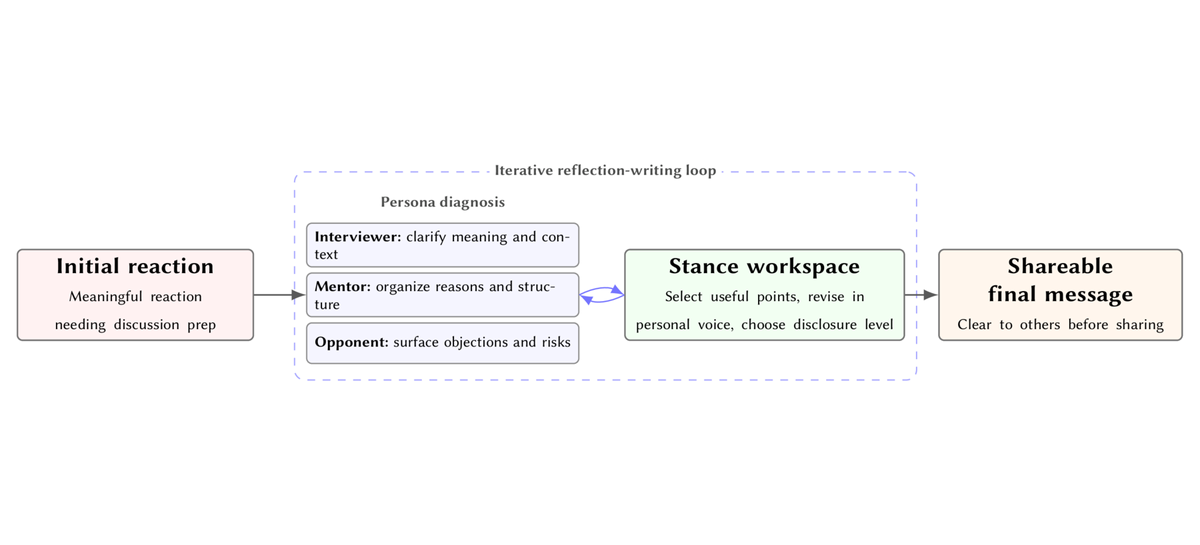
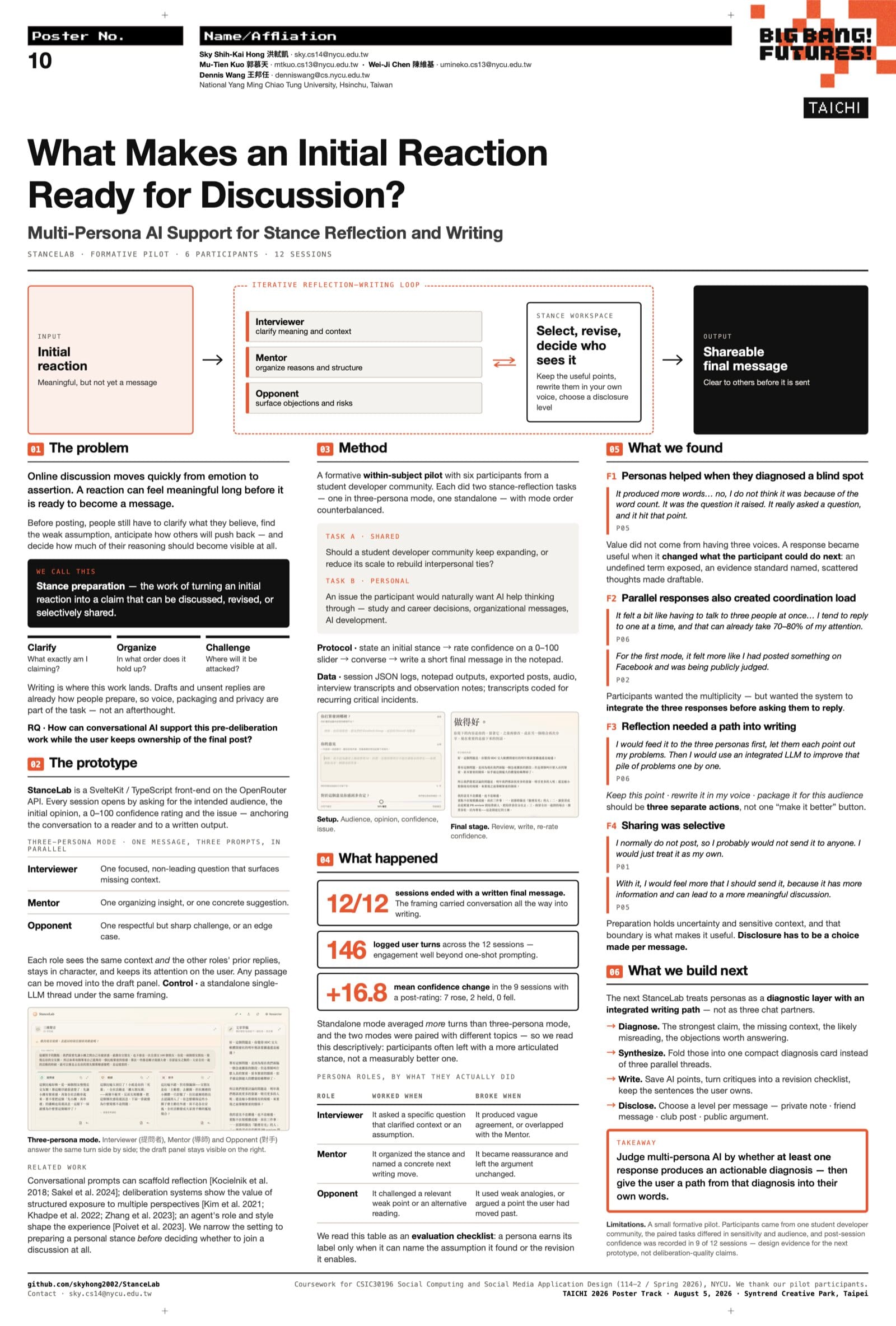
An initial reaction to a social or community issue can feel meaningful before it is ready to become a message: people still need to clarify the claim, anticipate audience risks, and decide how much reasoning should become visible to others. StanceLab is a prototype for preparing a stance before entering a discussion.
Stance preparation
We define stance preparation as the work of turning an initial reaction into a claim that can be discussed, revised, or selectively shared. This preparation involves at least three recurring moves: clarification, organization, and challenge. StanceLab instantiates each move as a persona:
Asks one focused, non-leading question to surface missing context.
Offers one organizing insight or concrete suggestion.
Gives one respectful but sharp challenge or edge case.
The study version includes two modes. In the three-persona mode, each user message is sent to the three role prompts in parallel. In the standalone mode, users interact with a single LLM under the same broad task framing.
Pilot study
Six participants from a student developer community each completed two stance-reflection tasks, one with each mode, in counterbalanced order. One task used a shared community prompt; the other was a personally relevant issue. Participants stated an initial stance, rated confidence on a 0–100 slider, conversed with the system, and produced a short final message in the notepad.
The strongest value of the three-persona mode came from relevant questions, objections, and redefinitions, but each role could also fail:
Worked when it asked a specific question that clarified context or assumptions.
Broke when it produced vague agreement or overlapped with the Mentor.
Worked when it organized the stance and named a concrete next writing move.
Broke when it became reassurance while leaving the argument unchanged.
Worked when it challenged a relevant weak point or alternative interpretation.
Broke when it used weak analogies or argued against a point the user had already moved past.
Multi-persona AI should be evaluated by whether at least one response produces an actionable diagnosis, and then give the user a path from that diagnosis into their own words. Next, we plan a diagnosis-and-writing workflow that turns persona-based reflection into selective, audience-aware final messages.
Poster
Citation
@inproceedings{hong2026stancelab,
  title     = {What Makes an Initial Reaction Ready for Discussion?:
               Multi-Persona AI Support for Stance Reflection and Writing},
  author    = {Hong, Sky Shih-Kai and Kuo, Mu-Tien and Chen, Wei-Ji and
               Wang, Dennis},
  booktitle = {TAICHI 2026 Poster Track},
  address   = {Taipei, Taiwan},
  year      = {2026}
}