
Keeping Everyone in the Game
Bringing Ability-Inclusive Family Co-Play to Unmodified Console Games

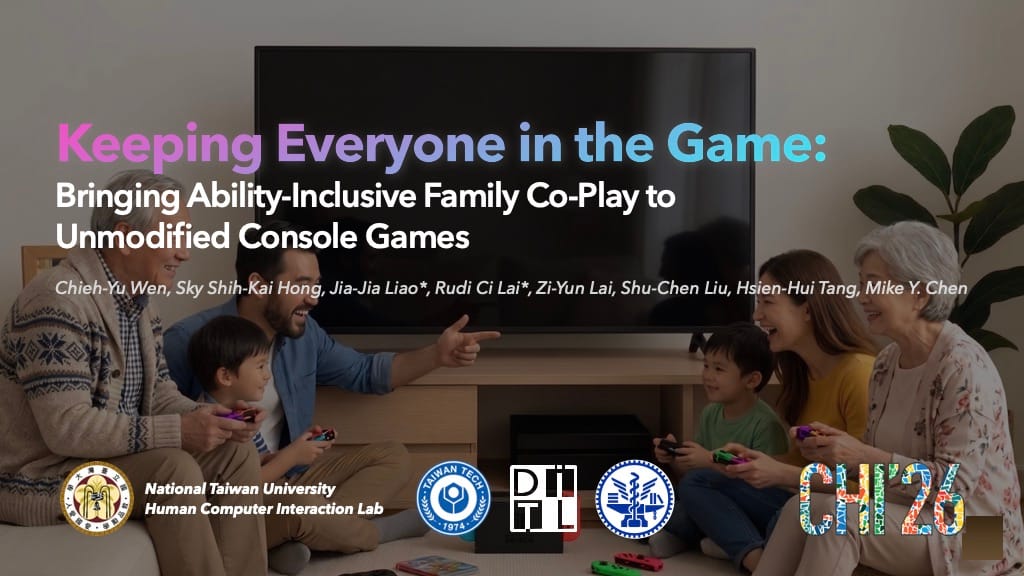
Family co-play of video games is common and linked to family closeness and positive intergenerational interaction. But mixed-age family play often involves large skill gaps: the younger brother keeps losing, leading to an argument, and he even just quits the game.
Our goal is Keeping Everyone in the Game: we want families to play the games they already love playing, but without anyone feeling left behind.
Controller Skills Benchmark
To better understand and quantify the skill gaps, we analyzed 112 mini-games from Mario Party Jamboree to identify 6 controller primary skills. Try the first four in your browser; your result is plotted against the 80 study participants.
Lifespan dataset: ages 6–90, n=80
As expected, the performance shows a U-shape lifespan trend. However, we found some unexpected insights.
Accuracy. While the 4-choice Reaction Time varies greatly across ages, the Accuracy remains highly stable across the lifespan.
Older Adults vs Children. Age-related decline is not uniform: gaps between children and older adults are skill-specific rather than uniform.
The open dataset also keeps every participant’s thumbstick trajectories:
PartyAssist
PartyAssist acts as a man-in-the-middle. It uses computer vision to track the game state from the screen in real-time, then modifies the user’s controller input before sending it to the Game Console. It works entirely outside of the game, meaning it supports any unmodified games.
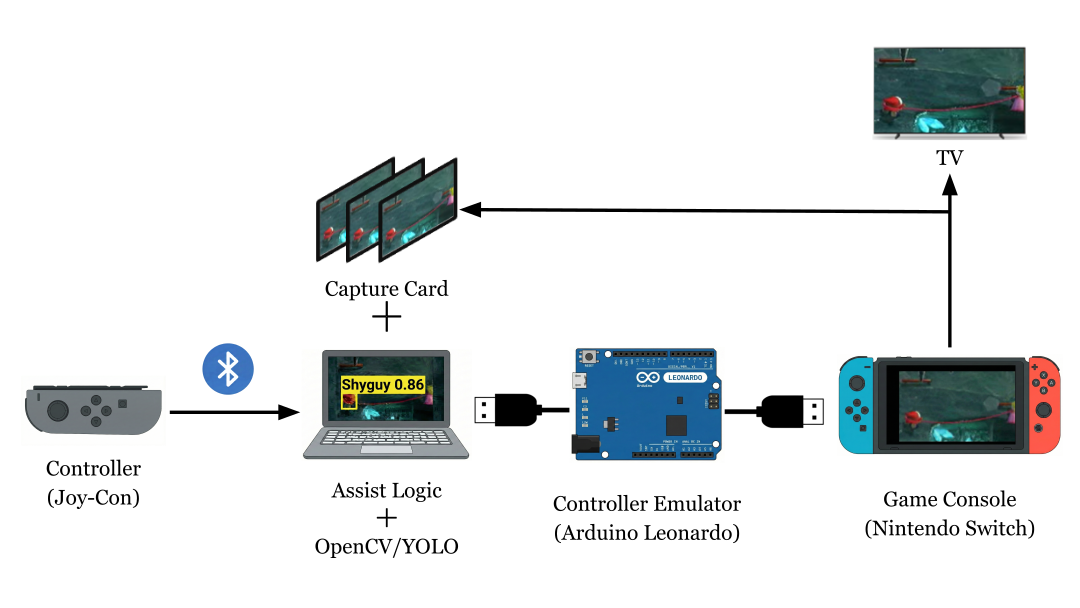
The Shy Guy highlighted with a bounding box is the assisted player, and the green text logs the most recent assistance provided. Outside of the exact moments when assistance is injected, the player is completely free to control their character.
Feasibility Study
16 mixed-skill dyads (n=32) of grandparents, parents, and siblings played five mini-games with and without PartyAssist, in a fully counterbalanced order. The assisted player was aged 6–8 or over 50.
At the end of the session, we revealed that they were actually being assisted in one of the conditions, and the two groups had almost completely opposite reactions:
This suggests that future assists should be socially-aware: when the goal is Relatedness, like a grandparent and grandchild, provide Equity; when the goal is Competence, like siblings competing, preserve Equality.
The Controller Skills Benchmark and Dataset are open-source on GitHub.
Citation
@inproceedings{wen2026keeping,
  title     = {Keeping Everyone in the Game: Bringing Ability-Inclusive
               Family Co-Play to Unmodified Console Games},
  author    = {Wen, Chieh-Yu and Hong, Sky Shih-Kai and Liao, Jia-Jia and
               Lai, Ruei Ci and Lai, Zi-Yun and Liu, Shu-Chen and
               Tang, Hsien-Hui and Chen, Mike Y.},
  booktitle = {Proceedings of the 2026 CHI Conference on Human Factors
               in Computing Systems},
  series    = {CHI '26},
  year      = {2026},
  publisher = {Association for Computing Machinery},
  address   = {New York, NY, USA},
  doi       = {10.1145/3772318.3791958}
}